The short answer
Socialization can include watching a person, hearing a distant vehicle or noticing a calm dog without approaching. Choose comfortable distance, keep experiences brief and let your puppy disengage. Good experiences matter more than collecting encounters. Ask your veterinarian how to balance early learning with local infection risks.
When you bring home a puppy, people often want to help by saying hello. In a busy building, the result can be a string of hands, voices and dogs from the front door to the street. Your puppy does not need to meet every one of them. Learning that nearby people can simply continue with their day is a useful part of city life.
Puppy socialization without greetings is not social isolation. It is a deliberate way to offer manageable information while preserving choice. Some puppies benefit from carefully arranged positive interactions too, but those should be selected for comfort and safety. The count on a checklist matters less than what the puppy appears to learn from each experience.
Before you start
- A secure harness and leash or suitable comfortable carrier
- Small rewards your puppy can eat easily
- A quiet observation spot with an exit
- A brief record of distance, response and recovery
A practical starting point
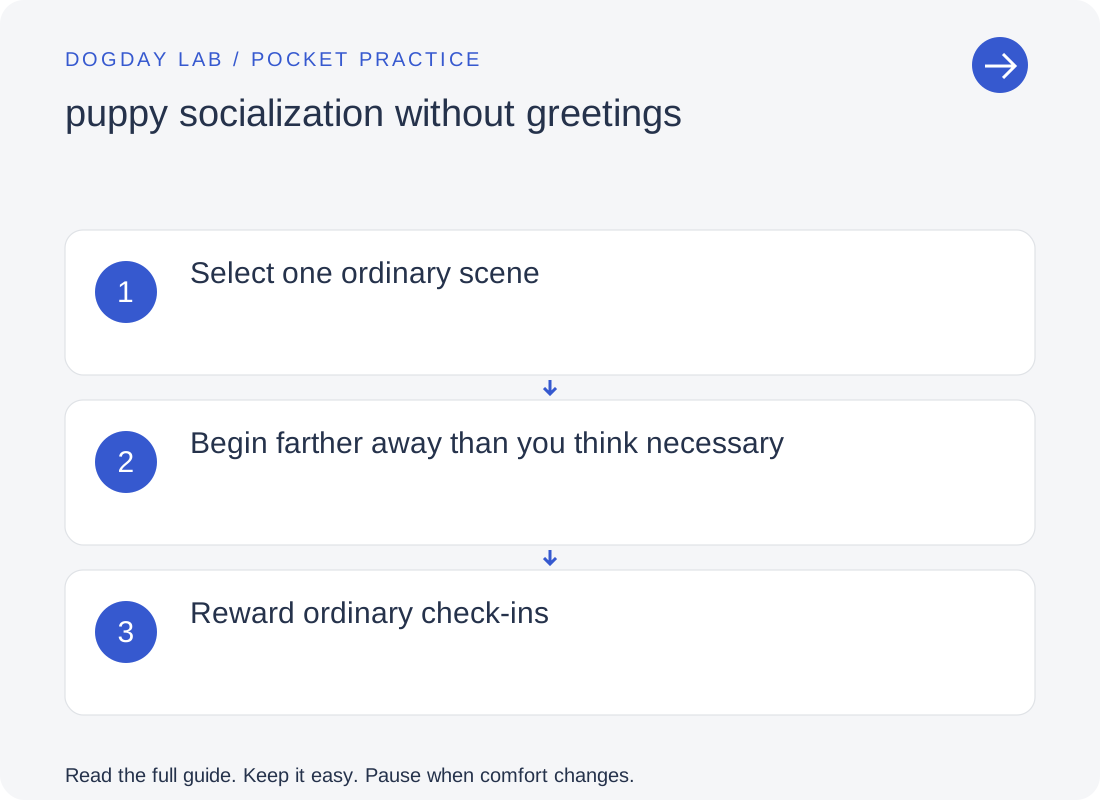
Select one ordinary scene
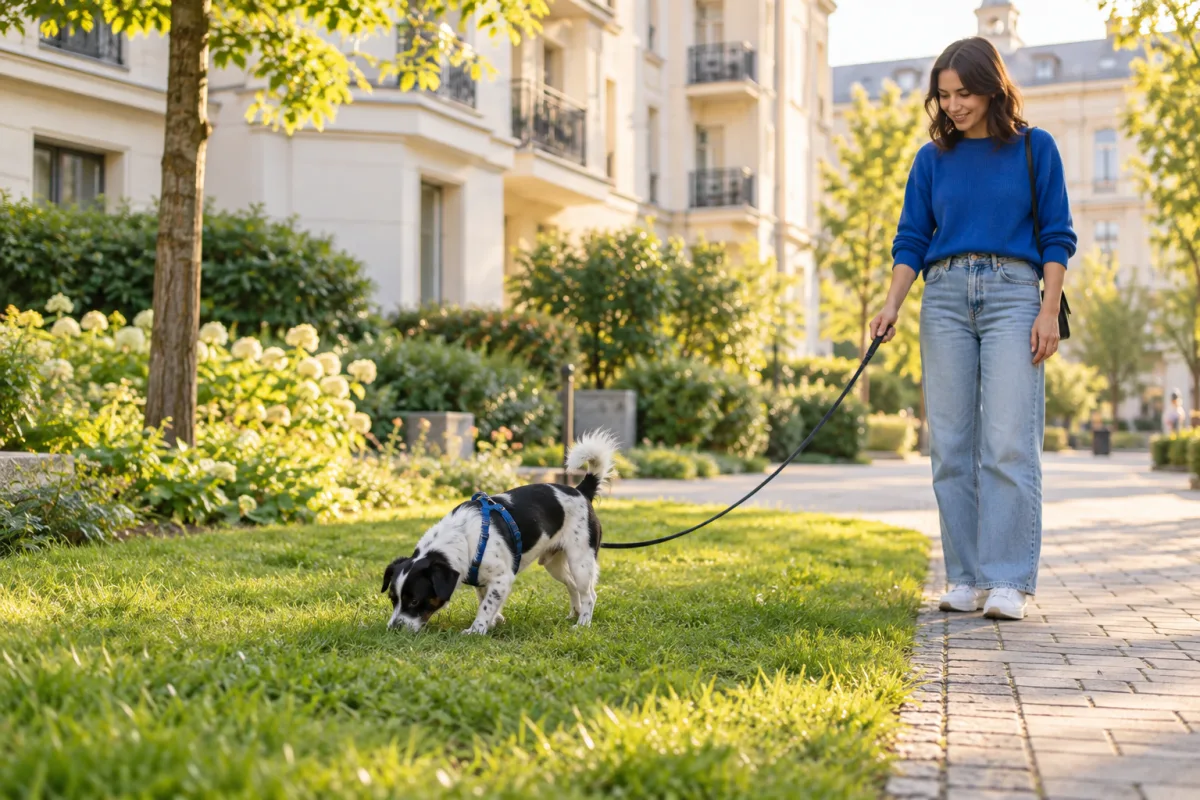
Choose a modest scene such as a person walking across an open space or a quiet delivery vehicle parked at a distance. Avoid arranging a crowd of new experiences at once. Check the location against your veterinarian’s guidance about disease risk and suitable outings. Your first objective is simply that the puppy can notice the scene comfortably, not that they remain still while it gets closer.
Begin farther away than you think necessary
Find a position with space to retreat and without people approaching from every direction. A doorway, narrow pavement or lift lobby may provide poor escape options. Let your puppy look around. If they become tense, hide, freeze, repeatedly try to leave or cannot engage in their usual way, increase distance or leave. You do not need to wait for barking to decide the setup is too difficult.
Reward ordinary check-ins
When your puppy glances toward you or turns away from the scene, offer a suitable reward. Do not hold food in front of a stranger to draw the puppy closer. You want the puppy to retain the ability to choose distance. Eating is one observation among several; a puppy can take food while still feeling conflicted, so keep watching movement and posture.
Let a non-event stay a non-event
If a passerby walks past and your puppy calmly continues sniffing, that can be a complete success. Resist calling the person back for a greeting to make the exercise feel worthwhile. Your puppy has just experienced someone nearby without needing to interact. End the observation or move to an easy activity before the puppy becomes tired of the situation.
Make a polite human boundary
Prepare a short phrase such as, We are practicing watching today, thank you. Say it early enough that the person has time to give you space. You can step aside without apologizing for your puppy’s needs. If someone ignores the request, move away rather than using your puppy to teach the stranger a lesson. A friendly public interaction is optional; safety is not.
Change the scene gradually
On another occasion, observe a similar event in a slightly different setting or at a comfortable new distance. Change one useful variable. A person with an umbrella, a rolling suitcase and an approaching dog together is a very different experience from a single pedestrian. Repetition of easy scenes helps you see what your puppy can handle before adding complexity.

What you are teaching when nothing happens
A puppy can learn that a person walking nearby does not always predict touching, food or play. That expectation is useful on city pavements, in apartment hallways and around outdoor seating. You are not trying to suppress interest. You are making it possible for your dog to notice everyday life without every sight becoming an invitation they must pursue.
For example, you might sit well away from a quiet path and allow your puppy to observe two people passing during a short visit. If your puppy remains loose, chooses to sniff and returns attention to you, there may be no reason to stay for ten more people. The learning opportunity is in the manageable experience, not in how much time you occupy the bench.
Socialization is broader than meeting people and dogs
Sounds, surfaces, movement, household equipment and different spaces can all be part of a puppy’s experience. Choose what is relevant to the life your puppy will lead, while keeping exposure manageable. An apartment puppy may need comfortable familiarity with keys, a stroller at a distance and a lobby floor more urgently than a crowded festival.
A varied week can still be quiet. One day might include watching a distant bicycle; another could involve hearing a very soft household recording while playing comfortably. These are examples, not a list that must be completed. If an experience produces fear, make a smaller plan and seek help when needed rather than returning at the same intensity to finish the checklist.
Balance infection precautions with learning opportunities
Speak to your veterinarian about your puppy’s vaccination status, local disease risk and appropriate locations. There is no single internet rule that makes every pavement, class or dog safe. Early learning matters, but health precautions should be specific to your puppy and area. Avoid unknown high-traffic dog areas unless your veterinarian has advised that they are appropriate.
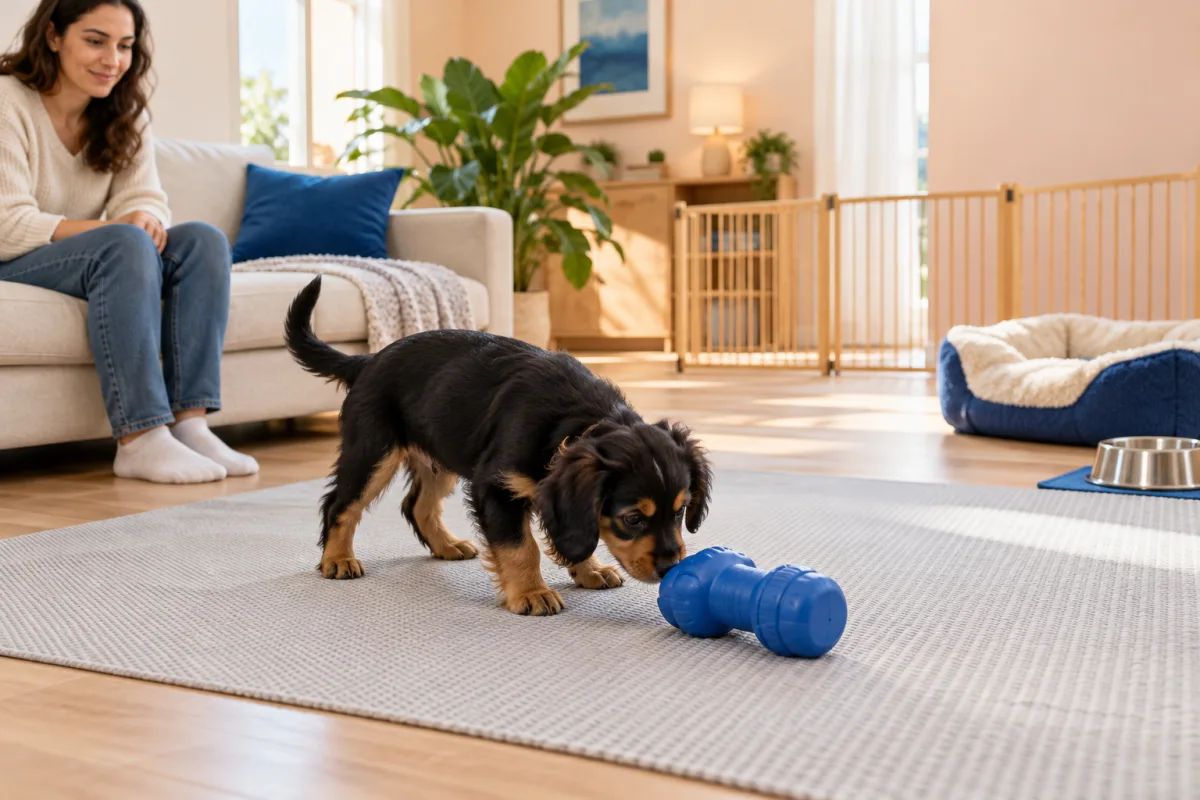
A comfortable carry, secure carrier or observation from a suitable private space may provide options when ground access is restricted. These alternatives also need training and safe handling. A puppy who struggles in your arms is not automatically comfortable because their paws are off the ground. The social experience and the transport arrangement must both work for them.
Choosing an actual greeting when it is useful
If you arrange an interaction, choose a calm person who can follow your instructions and let the puppy approach or decline. Keep the encounter brief and stop before the puppy feels crowded. A person leaning over, reaching repeatedly or blocking the retreat can turn a friendly intention into pressure. Food should not be used to lure a worried puppy into touching distance.
For dog interactions, select a suitable healthy dog and a safe setting with professional advice where needed. Avoid assuming that any adult dog will teach a puppy manners. A puppy does not need to be frightened or corrected to become socially competent. Structured puppy classes can be helpful when their health policies, group management and reward-based methods are appropriate.
Reading the whole puppy
Look for the combination of posture, movement, choices and recovery. A puppy who can look away, explore and move with a loose body may be having a manageable experience. A puppy who repeatedly freezes, leans away or tries to climb into you needs an easier situation. Do not interpret a still puppy as automatically calm.
Context matters. A yawn on its own does not diagnose stress, and a wagging tail does not prove that a greeting is welcome. Compare what you see with your puppy’s usual behavior in a comfortable setting. If you are unsure, choose more distance and ask a qualified professional to help you recognize your puppy’s individual signals.
An observation log that protects quality
Record the scene, approximate distance and what your puppy chose to do. A useful entry might say: two pedestrians across the courtyard; puppy watched, sniffed the ground, ate normally and turned back to me. The next step could be to repeat that comfortable scene, not automatically move closer.
A less comfortable entry might say: suitcase rolled out of the lift beside us; puppy backed away and needed space. The response is to avoid that surprise where possible and arrange a much easier version later. Do not use the log as a scoreboard that rewards the largest number of exposures. Its purpose is to help you plan settings your puppy can handle.
When the puppy wants to greet everyone
An enthusiastic puppy still benefits from predictable boundaries. Give enough distance that you can reward a glance back and continue your route without a struggle. On some occasions, an appropriate greeting can be offered after a comfortable pause, but do not demand a long sit while the puppy is pulling toward someone at arm’s length. That setup is unnecessarily difficult.
Alternate planned interactions with ordinary passing at a distance. Keep your leash handling gentle and avoid jerking the puppy away. If greetings are always the result of straining toward people, your routine may be teaching exactly the expectation you hoped to avoid. Change the environment and sequence rather than blaming the puppy for following that pattern.
A small practice plan for a busy building
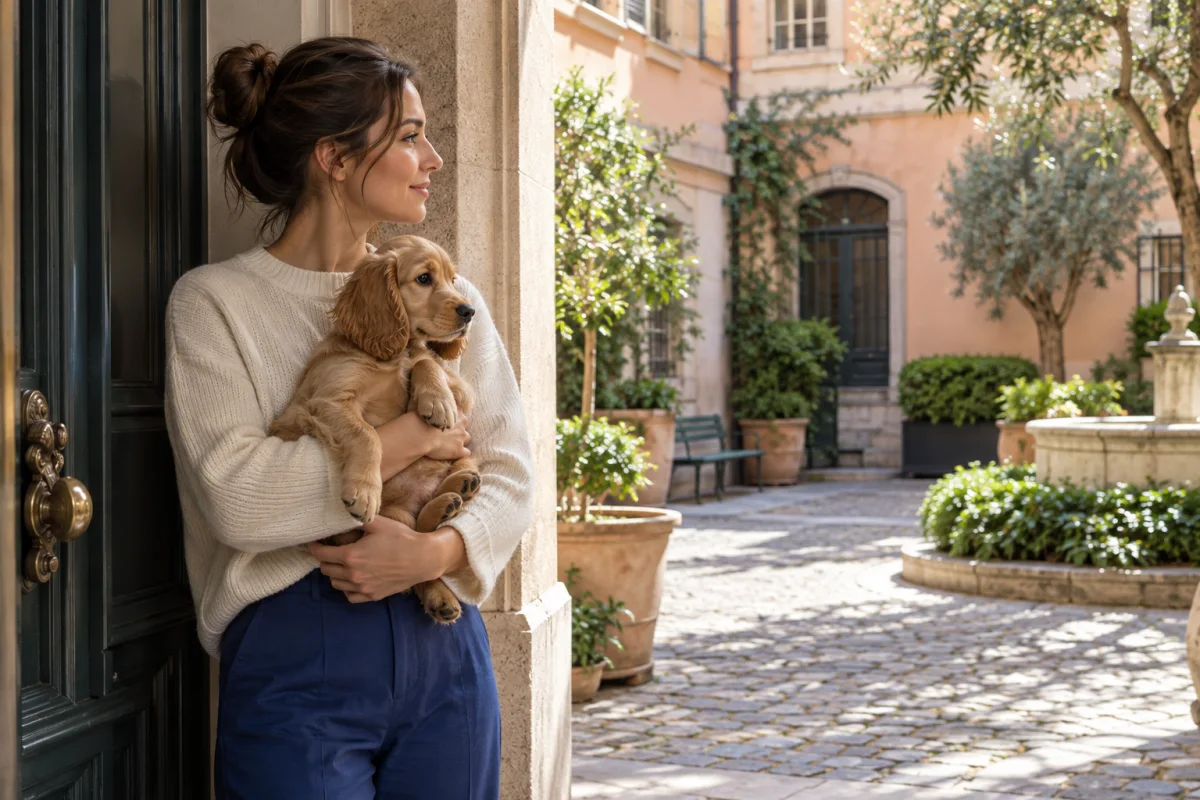
Start indoors with an adult opening and closing an internal door softly while the puppy has room to choose distance. Later, at a quiet time, observe the building entrance from a suitable position without waiting in the busiest path. Leave before the next rush if the area begins to fill. Your apartment entry should remain a place you can pass through, not a permanent training station that obstructs neighbors.
If the lift opens to reveal a dog or a group of people, you can wait for another journey. That decision is practical management. On a different day, a planned observation of one familiar person across the lobby may be enough. These modest experiences are often easier to repeat comfortably than a large outing that requires several days of recovery.
Choose a stopping rule before you arrive
A stopping rule can be simple: leave after one comfortable observation, when the area becomes busier, or at the first sign that the puppy needs more space. Decide it before the outing so you are less tempted to stay because you traveled there. You can always arrange another easy experience on a different day.
The rule should include the human environment too. If strangers repeatedly approach despite your request, the location may not support the exercise. Moving elsewhere is a sensible choice, not avoidance that will ruin socialization. A quiet successful observation at a less impressive location is more useful than remaining in a scene where you cannot protect the puppy’s comfort.
When it gets tricky
People keep touching my puppy without asking.
Increase physical distance early, choose quieter locations and position yourself to manage the interaction without trapping your puppy. State your request plainly. If the setting makes boundaries impossible, leave and use another place. Your puppy does not need to tolerate unwanted handling to become friendly.
My puppy hides behind me when someone passes.
Allow the retreat and make more space. Do not coax the puppy forward with food or ask the person to reach toward them. Watch whether your puppy recovers once the pressure is removed. Repeated fear, difficulty recovering or worsening responses warrant guidance from a qualified reward-based professional and your veterinarian.
The puppy is excited rather than afraid.
Excitement can still make learning difficult. Use more distance, shorter observations and familiar easy activities. Reward voluntary disengagement rather than repeatedly calling the puppy away from a situation that is too intense. A comfortable observation does not have to include a formal stay or continuous eye contact.
Common questions
Will avoiding greetings make my puppy unfriendly?
Watching without greeting is compatible with carefully chosen positive social interactions. The aim is a flexible response to everyday life, not avoidance of every person. Let quality and your puppy’s comfort guide the balance. If your puppy seems fearful across many settings, get individualized advice rather than simply increasing exposure.
How many new things should my puppy see each day?
There is no universal quota. A single well-managed experience may be plenty on a busy day, while another day may contain several small familiar variations. Include rest and consider the whole workload. More exposure is not automatically better when the puppy is overwhelmed or unable to recover.
Should I ask for a sit whenever another dog appears?
Only use a cue the puppy can comfortably perform in that setting, and do not rely on it to replace distance. Being free to move away may be more helpful than holding a position. For a puppy who is worried or highly excited, first change the environment and keep the encounter manageable.
Sources & further reading
These sources support the training and welfare principles discussed. Examples are illustrative; source organizations do not endorse this site.
General education, not an individual assessment. Pain, sudden behavior change, panic, aggression or bite risk need appropriate professional support. Editorial images are illustrative.