The short answer
Plan your dog’s care around your actual work commitments, then teach comfortable low-interaction periods when you are available to help. Provide suitable activity, toilet opportunities and rest without relying on exhaustion. Arrange care for meetings or absences your dog cannot manage, and keep independence practice separate from urgent work deadlines.
Working at home means you are physically present, but your dog may not understand why you are suddenly unavailable behind a screen. Meetings, delivery sounds and frequent trips to the kitchen can make the day unpredictable. A workable routine gives both your job and your dog’s needs a realistic place.
The aim is not to make a dog invisible during office hours. It is to arrange care, create comfortable periods of ordinary rest and prepare for moments when you cannot respond immediately. Puppies, senior dogs and dogs with health or separation concerns need individual adjustments. Start with the dog you have rather than a standard office-day template.
Before you start
- A realistic work calendar
- A comfortable resting area with water available
- Suitable low-demand activities
- A care backup for uninterrupted commitments
- A short record of activity, rest and difficult transitions
A practical starting point
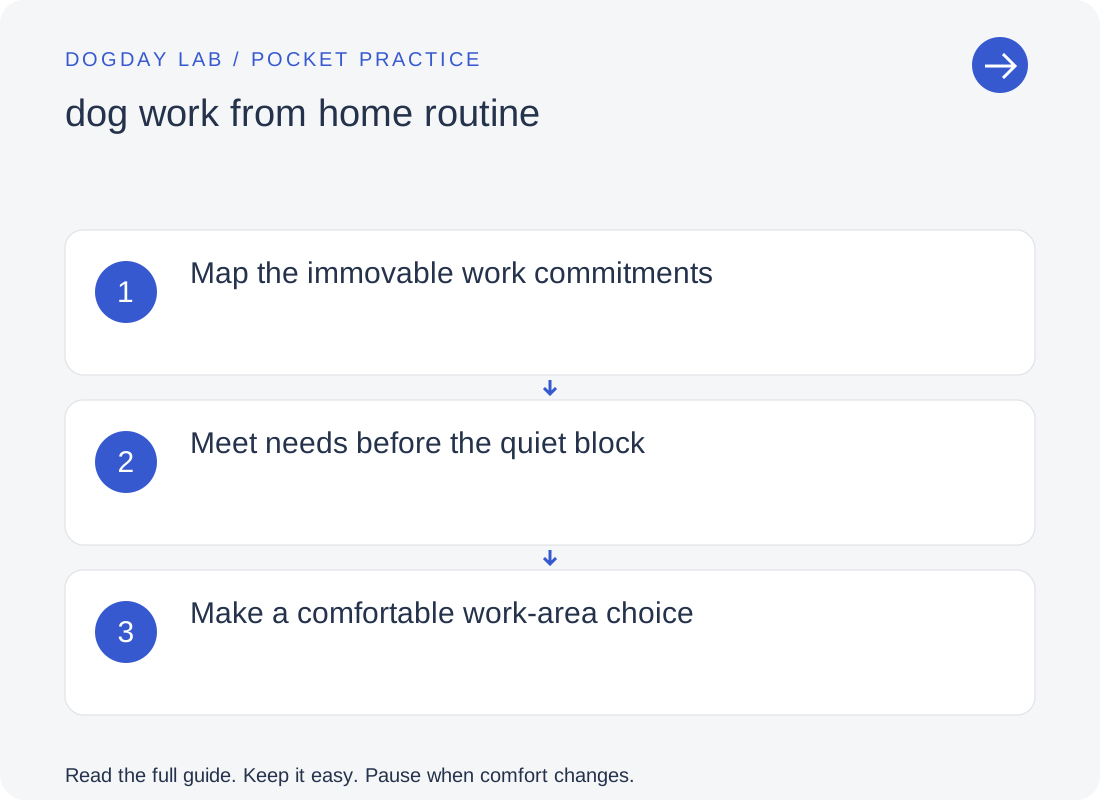
Map the immovable work commitments
Identify calls, deadlines and periods when you cannot safely interrupt your work. Include preparation and follow-up time, not only the meeting itself. Then compare those blocks with your dog’s current care needs and ability to rest. Where there is a mismatch, arrange another person or a different work arrangement rather than expecting training to solve it immediately.
Meet needs before the quiet block
Offer appropriate toilet access, activity and ordinary care before you begin a period of focused work. Choose activity suited to your dog’s age, health and preferences. A comfortable sniffing opportunity may be more useful than an intense game. Leave time for recovery instead of returning from an exciting outing and immediately demanding stillness.
Make a comfortable work-area choice
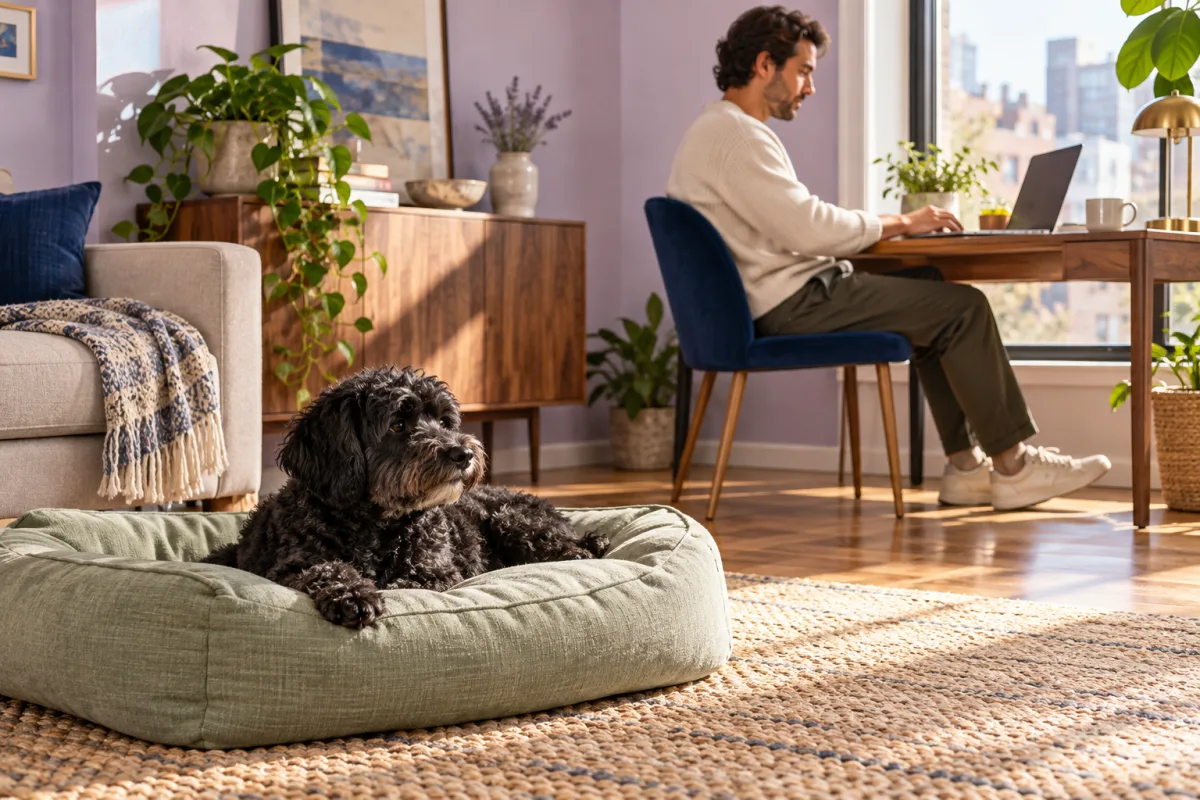
Provide a resting place where your dog can be near enough to feel comfortable without being under chair wheels or tangled in cables. Allow another safe resting option if they prefer it. If a barrier or separate room is needed, introduce it gradually outside urgent work periods. Do not make the first closed-door experience coincide with an important presentation.
Rehearse short low-interaction periods
At a time when you can respond, sit at the desk briefly and do a simple task. Let the dog settle without asking for a long stay. Quietly support comfortable behavior and finish before the setup becomes difficult. Build from what the dog can manage, keeping the practice separate from a real deadline.
Use predictable care transitions
When a work block ends, offer a recognizable break sequence suited to your dog: toilet opportunity, gentle movement, a short game or calm companionship. You do not need to make every break exciting. Keep the sequence clear enough that the dog is not repeatedly waiting for a large event whenever you touch the keyboard.
Review the routine when work changes
A new meeting pattern, office day or household member can alter what the dog experiences. Adjust the care plan first and introduce changes gradually where possible. Record which work blocks are comfortable and which need support. Do not assume that because you are still at home, the dog’s experience is unchanged.

Presence and availability are different
A dog may be used to receiving interaction whenever you are home. When work begins, your attention changes while your physical location stays the same. That can be confusing, especially if some requests get an immediate game and others are met with frustration. A predictable routine helps the dog learn what ordinary work periods look like.
Predictable does not mean ignoring all requests. A dog may need to toilet, be uncomfortable or be worried about something in the environment. Check needs and context. The goal is to reduce unnecessary uncertainty, not to train the dog never to communicate during business hours.
Start with the calendar you actually have
List the periods that truly require uninterrupted attention and distinguish them from work that can be paused. Many people design a routine around an ideal quiet morning, then discover that their longest call overlaps with the dog’s usual active period. A realistic calendar makes that conflict visible before it becomes daily stress.
For a puppy, a short break between meetings may not meet the full care need. For a dog with separation distress, a closed office door may be difficult even when another room is nearby. Arrange appropriate help and seek professional guidance rather than using a general work-from-home schedule as proof that the dog should cope.

Give the resting area a practical location
Place the bed away from rolling chair paths, cables, hot equipment and a doorway that opens suddenly. Consider whether a window view repeatedly draws the dog into barking or whether hallway sounds make rest difficult. A small change in position can reduce the number of interruptions without asking the dog to suppress every response.
The resting place should remain comfortable outside work hours too. If it appears only before you become unavailable, it may predict frustration rather than relaxation. Let the dog use it freely during ordinary quiet time, and avoid requiring a rigid position throughout the workday. Rest includes changing posture and choosing a safe comfortable spot.
A sample sequence for a flexible morning
An adult offers suitable care and a modest outing, then returns with enough time for the dog to drink and settle. The first work block is chosen around the dog’s comfortable capacity, with the adult still able to respond. A break follows before the next more demanding commitment. If a long call is unavoidable, another caregiver covers that period.
This sequence is illustrative, not a fixed timetable. A young puppy may need much more frequent care, while an adult dog may rest comfortably for longer. A dog recovering from illness may need a different plan entirely. The useful principle is matching commitments to observed needs and arranging help where they do not align.
Do not make exhaustion the attendance requirement
It can be tempting to add more exercise until the dog sleeps through every meeting. That strategy may be physically inappropriate, difficult to sustain and ineffective when excitement makes settling harder. Choose balanced activity and consider how the dog feels afterward, not only how much distance was covered.
Sniffing, gentle play, appropriate enrichment and ordinary social contact can all contribute to a satisfying day. None guarantees a nap at a particular time. If your work requires certainty, use a care arrangement rather than trying to engineer sleep through fatigue. Persistent restlessness deserves a broader review, including health.

Separate desk practice from separation practice
A dog resting beside your desk is learning something different from a dog left alone in another room or in the home. Do not assume one ability proves the other. If you will eventually return to office work, plan gradual appropriate preparation and care cover rather than waiting until the first commute.
For a dog who struggles when you move away, begin with manageable changes and professional support where needed. A food toy does not automatically make an absence comfortable. Observe the whole response and do not prolong distress to finish a work task. Practical care arrangements give training the space to proceed at a suitable pace.
Handle interruptions with a decision sequence
When the dog approaches, first check whether a need is likely: toilet, water, discomfort, social concern or a disturbing sound. If needs are met and the dog is comfortable, offer the familiar resting setup or an appropriate brief alternative. If the pattern repeats, change the routine rather than repeatedly responding with irritation.
For example, a dog who interrupts just after a delivery may need a quieter resting location and a delivery management plan. A dog who interrupts at the end of every long call may need that care break scheduled earlier. The timing of the behavior often tells you where the plan needs adjustment.
Choose enrichment that fits the level of supervision
A suitable familiar activity may help a dog during a quiet work block, but check whether it requires monitoring. A new chew, destructible toy or food puzzle can create risks if you are absorbed in a call. Introduce items while you can supervise and follow appropriate product and veterinary advice.
Do not offer increasingly difficult puzzles just to occupy more time. Frustration, guarding or frantic interaction are reasons to simplify or stop. Some dogs settle better after a simple familiar activity; others prefer a quiet resting opportunity without another task. Match the plan to the individual rather than filling every work block with a product.
Share responsibility across the household
If several adults work at home, assign care windows explicitly. Being in the next room does not mean someone is available. A shared note can show the last toilet trip, meal and current rest state so care is not duplicated or missed. Agree on how to request help during a call.
Also coordinate arrivals and breaks. One person starting a noisy game beside another person’s meeting can undermine the routine. This is a human scheduling issue, not something the dog should be expected to solve. Clear responsibilities reduce both frustration and inconsistent expectations.
Measure whether the routine is sustainable
Look for comfortable rest, manageable transitions and fewer last-minute care conflicts. Do not judge success solely by silence. A dog who is quiet but tense or unable to recover needs a different plan. Include your own ability to follow the routine without constant scrambling.
Review after a few ordinary workdays and change one practical element. You might move a walk, arrange a sitter for a recurring call or relocate the bed away from the window. If the dog remains distressed or needs cannot be met within the current work setup, seek appropriate professional and practical support.
Prepare for the first office day
If your work pattern may change, identify the care arrangement before announcing a sudden full-day absence to the dog. A dog who rests beside a desk has not necessarily practiced being alone in the apartment. Introduce the proposed sitter, walker or other support in manageable stages, and make sure their schedule covers the actual commute as well as office hours.
Keep a familiar element on transition days, such as the usual morning care sequence or a comfortable resting location. Record how the dog responds to the new arrangement and adjust support promptly. Do not use a difficult first office day as a baseline that must be repeated until the dog adapts. The aim is a workable care transition, with training proceeding at a pace the dog can handle.
When it gets tricky
My dog barks every time I speak on a call.
Practice the specific call cues separately when you can help: sitting at the desk, wearing headphones and speaking briefly at a low-key volume. Begin with an easy version and arrange care for real calls. Also check whether your voice predicts excitement or whether notification sounds are the trigger.
The dog settles until I stand up.
Standing may predict an outing or interaction. Practice small ordinary movements during quiet periods without always starting an exciting event. Keep real care breaks predictable enough to meet needs. If movement causes distress rather than simple interest, seek individualized guidance and reduce the separation demand.
I cannot interrupt work often enough.
Treat that as a care-planning constraint. Arrange a suitable caregiver, adjust work blocks where possible or choose another practical support option. Training cannot remove a dog’s need for toileting, comfort, activity and companionship. A realistic support plan is more useful than repeatedly asking the dog to wait longer.
Common questions
Should my dog stay on a mat all workday?
No. A dog should be able to change position, access water and meet ordinary needs. A resting area can be useful, but a prolonged stay is not the same as relaxed downtime. Design a comfortable safe space and a care schedule rather than requiring continuous obedience.
Does working from home prevent separation problems?
Not automatically. Constant proximity and comfortable time apart are different experiences. Prepare gradual manageable independence where appropriate and arrange care for absences beyond current ability. If your dog shows distress when separated, seek qualified help rather than assuming being home most days will resolve it.
Can I use the same routine every weekday?
A recognizable structure can help, but keep it responsive to health, weather, workload and the dog’s needs. Avoid treating exact clock times as promises the dog must follow. Preserve care and comfortable transitions while making practical adjustments when the day changes.
Sources & further reading
These sources support the training and welfare principles discussed. Examples are illustrative; source organizations do not endorse this site.
General education, not an individual assessment. Pain, sudden behavior change, panic, aggression or bite risk need appropriate professional support. Editorial images are illustrative.