The short answer
Ask a prospective trainer exactly what happens when a dog succeeds, struggles, or does an unwanted behavior. Verify relevant credentials, observe how they teach, and look for clear humane methods, realistic goals, and appropriate referral. Avoid guarantees and techniques based on pain, fear, intimidation, or forced exposure.
Choosing a trainer is partly about the dog and partly about the person who needs to learn the plan. A useful professional should explain what they will teach, how they will keep the situation manageable, and how you can practice safely between sessions. A polished website or a dramatic before-and-after video cannot answer those questions on its own.
This reward-based dog trainer checklist helps you prepare a conversation and compare services. It does not certify any individual or rank providers. If the concern involves pain, a sudden behavior change, severe fear, aggression, or bite risk, begin with your veterinarian and ask about appropriate behavior support. A general group class or app may not be the right level of help for that situation.

Before you start
- A concise description of your dog and goals
- Notes on health, behavior history, and safety concerns
- Questions about methods and credentials
- A way to compare service scope and costs
- Your veterinarian’s referral advice when relevant
A practical starting point
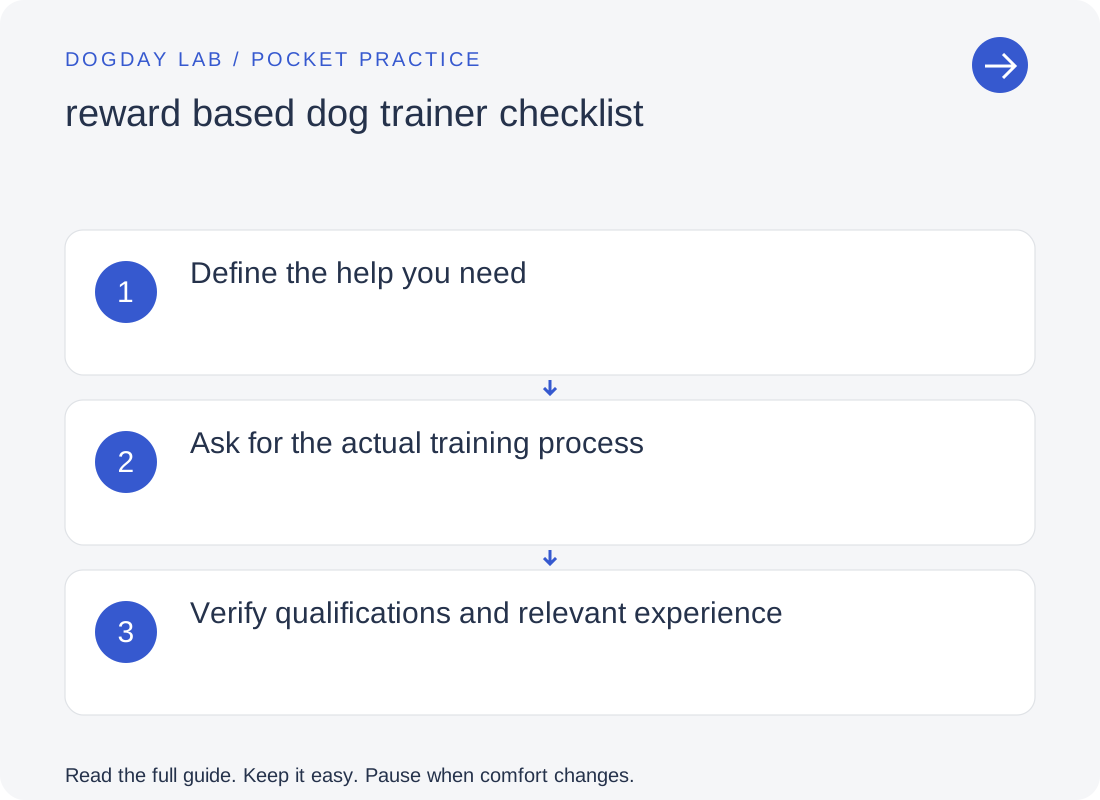
Define the help you need
Write one or two practical goals and the situations in which the problem occurs. Include health concerns, previous training, and any safety history honestly. Separate everyday skill teaching from complex behavior concerns. Ask your vet which type of professional is appropriate when medical factors, serious distress, or aggression may be involved. Do not choose a service only because it is nearby or available immediately.
Ask for the actual training process
Ask what the trainer does when the dog gets something right, when the dog does not understand, and when an unwanted behavior happens. Request concrete examples of equipment and actions. Terms such as positive, balanced, natural, or relationship-based can mean different things in marketing. The answer should make the methods clear without requiring you to decode a slogan.
Verify qualifications and relevant experience
Check claimed credentials with the issuing organization and ask what they assess. Discuss experience with needs like yours, ongoing education, and professional limits. A title alone may not tell you what training or assessment sits behind it. Credentials are useful evidence, but they should be considered alongside observed methods, communication, and suitability for the individual dog.
Observe teaching and safety where possible
Ask whether you can observe an appropriate class or sample teaching format without putting your dog into a difficult situation. Notice how the trainer responds to confusion, fear, and different learning speeds. Look for room to take breaks, clear management, and respectful coaching of people. Do not expose your dog to a risky demonstration merely to evaluate the service.
Agree on a realistic written plan
Before committing, clarify goals, session format, homework, support, fees, cancellation terms, equipment, and referral arrangements. Ask how progress will be assessed and what happens if the plan is not working. Avoid guaranteed outcomes or fixed promises that ignore the dog’s health and history. You should understand the next step and feel able to decline an action that seems unsafe or uncomfortable.

Match the professional to the problem
Everyday skills such as settling into a routine or learning an easy cue may suit an instructor who coaches owners. Complex behavior concerns can need a different level of assessment and coordination with a veterinarian. Titles and credential systems vary by country, so ask what the professional’s role includes and where their limits lie. A responsible referral is a useful sign of scope awareness.
Bring a factual description rather than a label alone. Dog barks at visitors does not explain whether there is fear, excitement, pain, or bite risk. Describe what happens, the context, and any history. Do not provoke the behavior to create a demonstration. The professional can tell you what information is needed and how it can be gathered safely.
Ask what happens after success, confusion, and mistakes
A clear answer about methods describes actions. How is a desired behavior rewarded? How is the task made easier when the dog struggles? How is the environment arranged to prevent unsafe repetition? What equipment is used? What would the trainer do if the dog growled, tried to leave, or could not respond? These questions reveal more than asking whether they love dogs.
Look for a plan that teaches useful alternatives and adjusts the setup. Avoid techniques that rely on pain, fear, intimidation, harsh corrections, or forcing the dog to remain overwhelmed. The current AVSAB humane-training position supports reward-based methods. Do not accept the idea that a difficult dog automatically requires aversive treatment or that discomfort is justified by a dramatic short-term result.

Verify credentials without treating them as a guarantee
Ask for the exact credential name and check it with the organization that issues or maintains it. Find out whether it involves assessment, experience requirements, continuing education, and an ethical code. A course completion certificate, membership, and independently assessed qualification may represent different things. The distinction matters more than the number of letters displayed after a name.
Use credentials as part of the decision, not the whole decision. Ask about relevant experience and how the professional keeps knowledge current. Observe whether their actual methods match what they describe. If a claim cannot be verified or the person becomes defensive about ordinary questions, continue your search. No credential removes the need for humane practice and clear communication.
Look for someone who can teach the human
You need a plan you can understand and carry out. A useful instructor explains the goal, demonstrates at an appropriate level, watches your practice, and adjusts the explanation. They should account for your home, time, mobility, equipment, and other constraints. A technically impressive demonstration with the trainer’s own dog may say little about how they will help you learn.
Respect matters. You should be able to ask questions without being shamed for the dog’s behavior or your timing. The professional should not blame every difficulty on a lack of dominance or commitment. At the same time, honest coaching may include changing routines or management. The difference is that the changes are explained clearly and tied to achievable goals rather than pressure or humiliation.
Evaluate the environment and group format
For a group class, ask about space, number of dogs, barriers, breaks, entry and exit, and what happens when a dog is overwhelmed. A dog who needs more distance should not be forced into a crowded line of greetings. Check whether the class actually fits the dog’s current needs. An individual session or referral may be more appropriate than trying to make every dog suit the group.
For home or outdoor sessions, discuss the location and risk management in advance. The trainer should not require an unsafe off-leash test or create a confrontation to demonstrate authority. Clear management can be part of training, not evidence of failure. Gates, distance, suitable leashes, and easier setups can protect learning while skills develop.

Ask about outcomes without accepting guarantees
Useful goals describe observable changes in a defined context, such as a dog comfortably responding in a quiet room or a caregiver completing a safe routine. Ask how the trainer will decide when to progress and how the plan changes if the dog struggles. Good tracking includes the dog’s welfare and the household’s ability to follow the plan, not only fewer visible behaviors.
Be cautious of promises to fix every dog in a set number of days or guarantee permanent results. Health, history, environment, and practice all affect progress. A professional can explain likely work and service commitments without guaranteeing a behavioral outcome. Ask what support is available between sessions and when they would recommend reassessment or referral.
Understand the service before paying for a package
Clarify the total scope: session length and number, location, written plans, follow-up, messaging access, equipment, and any additional charges. Read cancellation, refund, and rescheduling terms. Ask who will deliver the sessions and whether you can observe or participate. A package should be a clear service agreement, not pressure to buy before your questions are answered.
If the service involves the dog staying elsewhere, ask detailed questions about daily care, methods, supervision, communication, and the transfer of skills back to you. Do not assume removing the dog from home removes the need for owner learning. Be wary of secrecy about techniques or refusal to explain how difficult situations are handled. Your dog’s welfare remains central regardless of the service format.
An example of comparing two answers
Imagine asking what happens if your dog cannot focus around another dog. One answer describes increasing distance, checking comfort, choosing an easier task, and rewarding a manageable response. Another promises to correct the dog until they stop reacting but does not explain the equipment or welfare risks. The first answer gives you a concrete humane process to evaluate; the second leaves important questions unanswered.
This is an illustrative comparison, not a claim about any named provider. Use the same approach with your actual goal. Ask follow-up questions until you understand what would happen in the session. If the proposed action relies on pain or fear, you can decline it. You do not need to let the trainer demonstrate on your dog before deciding the method is unsuitable.
Prepare for the first session and keep evaluating
Bring accurate health and behavior information, current veterinary advice, suitable rewards and equipment as requested, and a short goal list. Tell the trainer about any changes since booking. Agree on how to pause if the dog or person is uncomfortable. You should know what the first session is intended to accomplish and which activities will not be attempted.
Afterward, ask whether the plan was understandable, humane, and practical. Can you describe the homework and stop criteria? Did the trainer respond appropriately when the dog struggled? Were concerns taken seriously? A good start does not mean you stop evaluating. Continue to ask questions and seek a different professional or veterinary input when the arrangement no longer meets the dog’s needs.
Know how self-guided resources fit around professional help
Written guides, logs, and an app can help organize ordinary practice, but they cannot assess pain, diagnose behavior, or observe the full safety picture. Use them to record questions and support a plan agreed with the professional. Do not combine several conflicting programs without discussing the changes, especially when fear, aggression, or medical concerns are involved.
Tell the professional what you are practicing between sessions and bring useful observations. A clear record of setting, action, and response can help refine the plan. The aim is a coherent approach in which resources support real-world care and learning. No digital tool or checklist should be presented as a replacement for the level of help the individual dog requires.
When it gets tricky
The trainer’s website says positive but their answers are vague.
Ask for concrete actions and equipment in a situation relevant to your dog. Marketing language is not enough to assess methods. If the person will not explain what happens when the dog struggles or refuses, continue your search rather than assuming the label guarantees humane practice.
I am told my dog needs harsher methods because the case is serious.
Seek veterinary and appropriately qualified behavior support. Serious concerns require careful assessment and management, not an automatic shift to pain or intimidation. Ask for a clear humane plan and decline techniques you believe are unsafe or harmful.
I like the trainer but cannot manage the homework.
Discuss the practical constraint and ask for a smaller or differently arranged plan. A useful professional should help adapt practice while preserving welfare and safety. Do not silently improvise difficult exercises or assume more effort is the only solution.
Common questions
Is certification enough to choose a trainer?
It is useful evidence to verify, but also assess actual methods, relevant experience, teaching, and fit. Different credentials represent different assessment processes. Ask clear questions and observe appropriate teaching where possible.
Should I start with my vet?
Yes when pain, sudden changes, serious fear, aggression, or other health and safety concerns may be involved. Your vet can assess medical factors and advise on suitable behavioral referral. Everyday skill training may need a different service from a complex case.
Can a trainer guarantee results?
Behavior depends on many factors, so a fixed guaranteed outcome is a reason for caution. Ask instead about the service provided, realistic goals, progress criteria, support, and how the plan will be reviewed when difficulties arise.
Can I stop a session if I am uncomfortable?
Yes. You can decline an action and ask for an explanation or alternative. Protect immediate safety and welfare. A respectful professional should welcome clear communication rather than pressure you to accept pain, fear, or a risky demonstration.
Sources & further reading
These sources support the training and welfare principles discussed. Examples are illustrative; source organizations do not endorse this site.
General education, not an individual assessment. Pain, sudden behavior change, panic, aggression or bite risk need appropriate professional support. Editorial images are illustrative.