The short answer
Choose one non-urgent care task, divide it into small steps, and teach a clear way for your dog to participate and pause. Keep practice separate from necessary treatment, record the easiest comfortable version, and coordinate with your vet or groomer when care cannot wait for training.
Cooperative care training is preparation for handling, grooming, and veterinary routines. It aims to make those experiences more predictable and give the dog meaningful opportunities to participate. A useful plan does not begin with completing a nail trim or cleaning an ear. It begins with a much smaller question: what can this dog comfortably notice, approach, or accept today?
The plan below is for gradual practice around non-urgent tasks. It is not a medical treatment protocol or a reason to delay needed care. Pain, established handling fear, aggression, or bite risk require veterinary assessment and qualified support. When a procedure must happen before training is ready, ask the care team for an appropriate welfare and safety plan rather than forcing a training exercise to serve two incompatible purposes.
Before you start
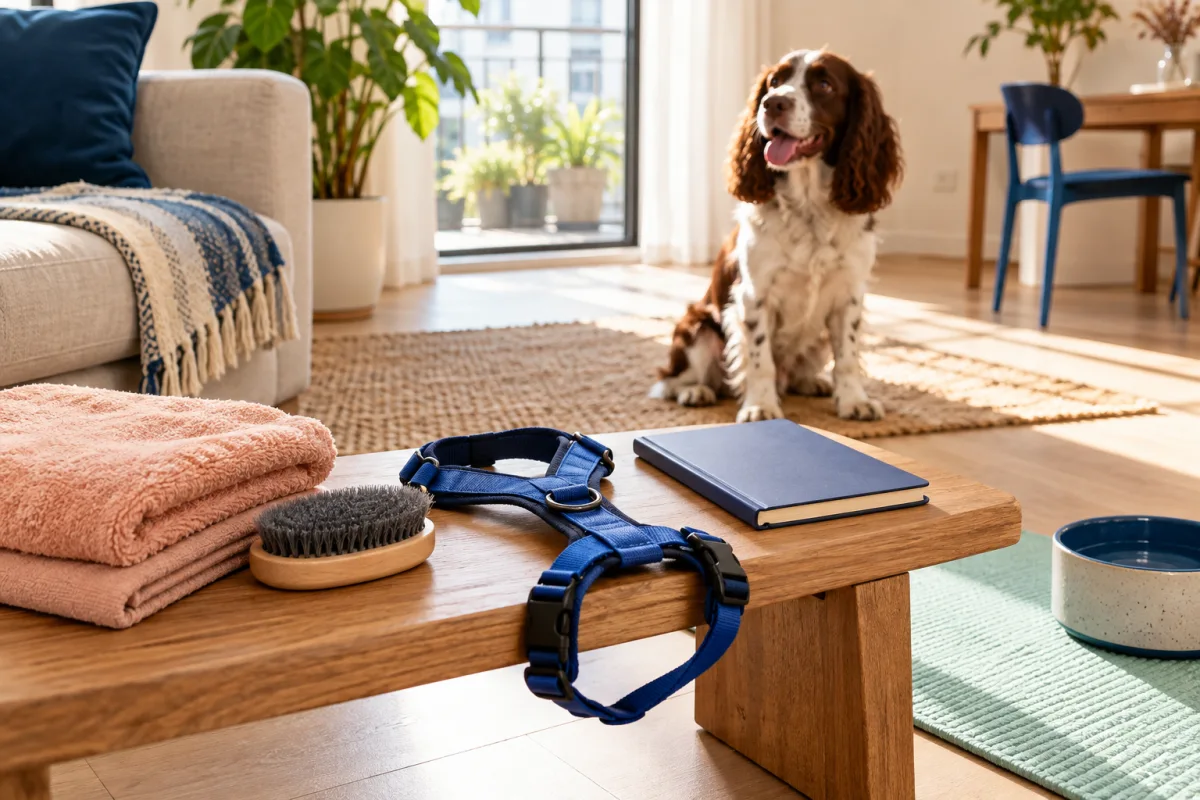
- A quiet familiar space with secure footing
- A suitable comfortable station or resting surface
- Rewards approved for your dog
- The relevant tool, initially at a comfortable distance
- A short training record and the care team’s instructions
A practical starting point
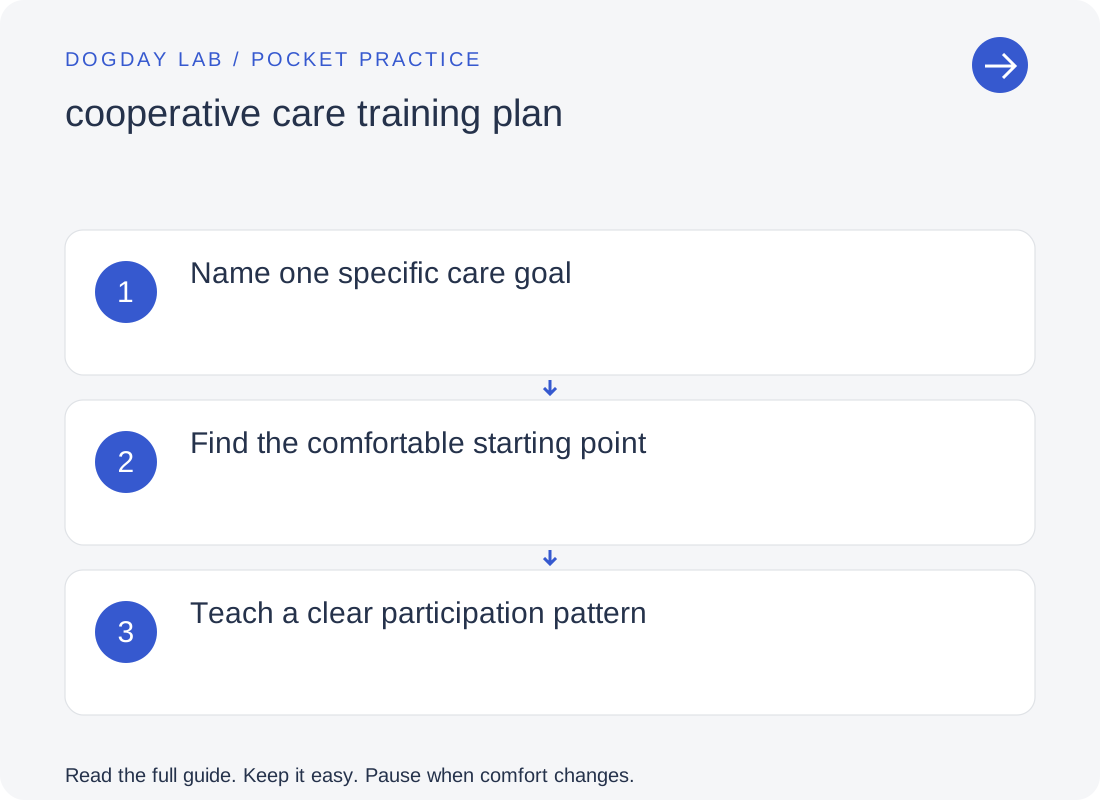
Name one specific care goal
Choose a task that is useful and not urgent, such as being comfortable with a towel nearby or allowing a brief touch to a familiar body area. Write what successful participation would look like. Avoid broad goals such as tolerate grooming. Check with the vet or groomer about health concerns, appropriate equipment, and which preparation would actually help with the eventual care task.
Find the comfortable starting point
Observe the dog without beginning the procedure. Can they rest near the tool, approach the station, or accept an ordinary familiar touch? Start before the first sign of concern, not at the point where the dog barely stays. A tool may need to remain across the room at first. Keep an exit available and avoid holding the dog in place to obtain a baseline.
Teach a clear participation pattern
Use a simple voluntary behavior suitable for the dog, such as approaching a station or resting comfortably in a chosen position. Reward that behavior separately before adding handling. Decide what will mean pause, such as moving away or changing position, and honor it during practice. A cue is meaningful only if the dog can stop the action by withdrawing participation.
Add one tiny part of the task
Show the tool, move a hand slightly, or make a very brief familiar touch, depending on the starting point. End the action and reward. Do not combine a new tool, longer duration, firmer pressure, and a different person in one step. If the dog hesitates, tenses, or withdraws, stop and make the next attempt easier. The reward should support learning, not hide a procedure the dog is struggling with.
Record and coordinate the next step
Write exactly what was comfortable: tool distance, body area, duration, position, person, and the dog’s response. Share useful details with the care professional. Progress only when the easier version is consistently comfortable, and change one factor at a time. If necessary care is due before the skill is ready, contact the professional rather than compressing many training steps into one pressured session.

Make the goal small enough to teach
A care task is a chain of separate events. Grooming may involve entering a room, standing on a surface, seeing a brush, feeling a hand, hearing equipment, and accepting movement of fur. Veterinary care can add unfamiliar people, smells, positions, and restraint. Write those parts down. You can then choose a small preparation skill instead of treating the whole procedure as one behavior.
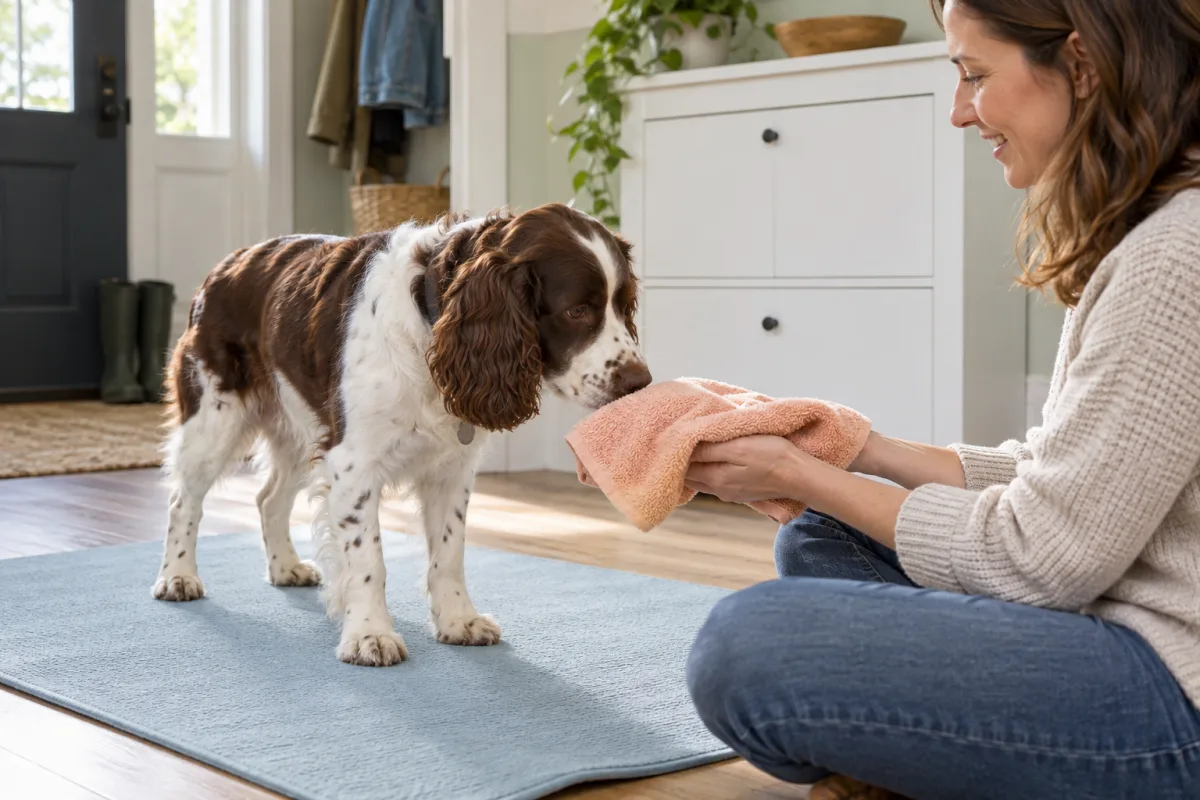
For example, comfort around a towel may begin with seeing it folded on a chair. The next useful step might be a person picking it up at a distance, not rubbing the dog from head to tail. The size of the step depends on the individual. A dog who already enjoys gentle touch may start closer to contact, while a worried dog may need professional help before any handling practice.
Participation signals need a real consequence
People sometimes call a chin rest, station, or offered body position a start button. The name matters less than the arrangement. During practice, the behavior signals that the next small action can begin, and withdrawing it stops that action. If the person continues regardless, the signal no longer gives the dog the control it appears to promise.
Choose a signal that is physically comfortable and easy to notice. It should not trap the dog or require them to hold a difficult position. Teach it without care equipment first. Keep other body language in view: a dog may maintain a trained position while becoming tense. A participation behavior does not override signs of discomfort or turn every procedure into voluntary care.
Keep practice separate from necessary procedures
Training can move at the dog’s pace because the immediate goal is learning. Necessary treatment may have a medical deadline. Discuss this difference with the veterinary team before the deadline arrives. They can advise on pain management, appropriate handling, medication where indicated, or other arrangements. Do not delay treatment while waiting for a perfect training behavior, and do not make medication decisions yourself.
Use different predictable contexts when the professional recommends them, so a practice session is not repeatedly followed by an unavoidable procedure that ignores the dog’s pause signal. After difficult care, return to an easier preparation plan with guidance. Honesty about limits protects the training process. Cooperative care is a useful aim, not a promise that all urgent handling can be made optional.
Rewards should not conceal discomfort
Use rewards that suit the dog and fit any dietary instructions. Deliver them in a way that leaves the dog able to move and communicate. A dog taking food is not proof that the handling is comfortable. Watch posture, tension, approach, and response to the next invitation. If food keeps the head still while the body pulls away, the task may already be too difficult.
For early practice, a tiny action followed by a reward can make the sequence clear. Avoid using food to lure the dog into a position where they are then held through an unwanted procedure. If the dog does not return after a pause, accept that information. Make a later session easier rather than increasing the reward until they endure the same uncomfortable step.
Change one dimension at a time
Care difficulty has several dimensions: tool distance, movement, touch location, pressure, duration, body position, environment, and person. A comfortable half-second touch in the living room does not automatically transfer to a longer touch on a clinic table. When one element changes, make the others easier. That gives you a clearer view of what the dog can currently manage.
Build in ordinary easy repetitions instead of increasing every time. For example, alternate the current small step with the familiar starting version. Stop while the dog is still comfortable, not after the first struggle. There is no universal number of days or repetitions. The care team can help identify sensible progression criteria for the task, especially when medical or grooming needs are involved.
An example planning sheet
Imagine the goal is a comfortable brief towel touch after a wet walk. The sheet might name the location as a nonslip mat near the entrance, the starting point as a folded towel on a nearby chair, and the first action as lifting the towel without approaching. The dog can leave. The person notes whether the dog remains loose, approaches voluntarily, and returns after a pause.
Later steps might involve the towel held nearer, then a brief touch to an area the dog already accepts, followed by a pause. Actual drying still uses only what the dog can safely manage, with professional advice if needed. The sheet should also say what to avoid: chasing with the towel, covering the head, holding paws tightly, or continuing through tension. Specific limits keep the plan useful to other caregivers.
Use a log that makes the next session easier
Record one line after each session: task, starting setup, action, response, and next adjustment. An example might be brush on table two steps away; dog approached mat, looked at brush, stayed loose; repeat same setup. Avoid scoring tolerance as a percentage or labeling refusal as stubbornness. The log should describe observable events that another person can understand.
If the dog withdraws, note what changed immediately before it. The person may have leaned over, the tool may have touched a new area, or the session may have lasted longer than usual. A useful next step is often to reduce that factor. If you see pain, escalating fear, or aggression, stop the practice and contact the appropriate professional rather than simply moving down a training ladder.
Prepare the whole care team
Share a concise current summary with the vet, groomer, sitter, or other caregiver. Include comfortable positions, known concerns, rewards, pause signals, and the latest easy step. Ask whether the proposed preparation is useful for their workflow. A professional may suggest a different target, surface, or setup that transfers more realistically to necessary care.
Keep claims modest. Saying the dog can accept a brief shoulder touch at home is useful; saying the dog is fully cooperative after one successful session is not. Different people and places can change the experience. Invite feedback after appointments and update the plan. The strongest result is better communication and a more comfortable pattern of care, not a badge that the dog must maintain.
Keep the latest version dated and easy to find. Remove old instructions when a professional changes the plan, so another caregiver does not unknowingly repeat a step that is no longer appropriate for the dog.
When it gets tricky
My dog keeps the position but looks tense.
Stop the action and offer a break. The trained behavior does not cancel the rest of the body language. Make the next practice easier and check for pain or other concerns with the vet. Do not reward the position while ignoring signs that the procedure is uncomfortable.
My dog leaves as soon as the tool appears.
The starting point is too difficult or the tool has an uncomfortable history. Put it farther away or remove it from the session, and practice a familiar voluntary behavior separately. For established fear, seek professional support rather than repeatedly presenting the tool until the dog stops leaving.
The procedure is due tomorrow.
Contact the care professional now. Explain what the dog can and cannot comfortably manage and ask for an appropriate plan. Do not rush a long training sequence overnight or delay necessary care without veterinary advice. Preparation can continue afterward at a suitable pace.
Common questions
Does cooperative care mean never restraining a dog?
It aims to increase comfortable voluntary participation, but medical care can have constraints. Discuss necessary handling with the veterinary team. Do not use a training signal to promise control and then ignore it during routine practice. Be clear about the difference between learning sessions and urgent care.
Do I need to teach a chin rest?
Not necessarily. The useful participation behavior depends on the dog, task, physical comfort, and professional workflow. A station or another easy position may fit better. Ask the care team what would help, and teach the behavior without adding handling immediately.
How long does this training take?
There is no fixed timetable. History, health, task complexity, and the environment affect progress. Use comfortable repeated participation as information, and keep care deadlines coordinated with professionals. A calendar should organize practice rather than force the dog through steps.
Can I practice with a painful body area?
Ask the vet first. Pain requires assessment and treatment, and repeated touching can make the experience worse. Do not use training to test whether pain is real. Work on unrelated comfortable preparation skills only when they fit the veterinary plan.
Sources & further reading
These sources support the training and welfare principles discussed. Examples are illustrative; source organizations do not endorse this site.
General education, not an individual assessment. Pain, sudden behavior change, panic, aggression or bite risk need appropriate professional support. Editorial images are illustrative.